
The short answer
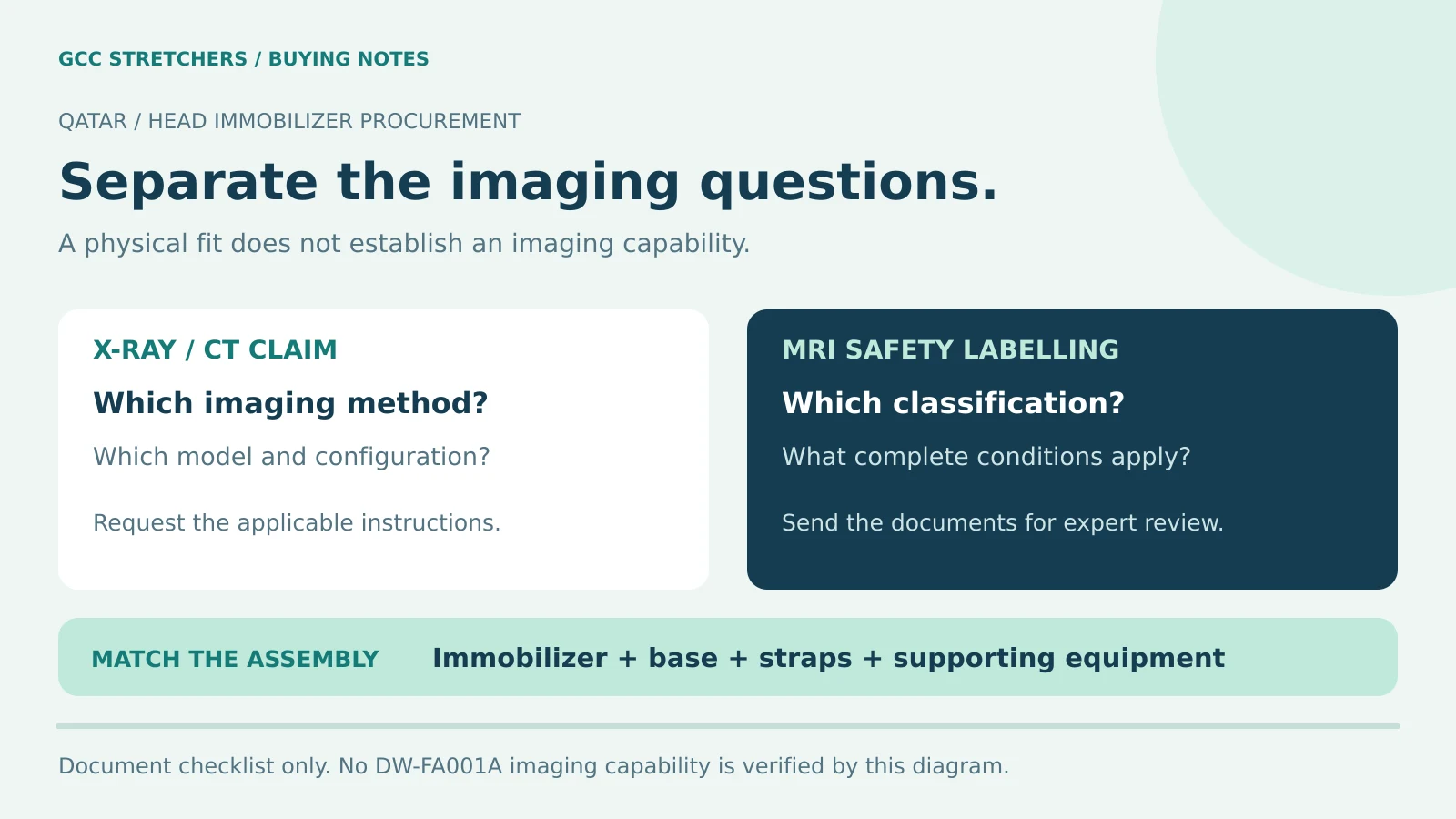
Board fit, X-ray or CT compatibility and MRI safety are separate questions. Ask for documentation identifying the exact head immobilizer, straps, base and supporting equipment. DW-FA001A describes an adult head immobilizer, but the available catalogue does not verify an imaging capability. Do not treat its coated-foam construction, or a claim about another product, as imaging approval.
When a Qatar purchasing team compares head immobilizers, a short phrase such as “imaging compatible” leaves important details unanswered. Which imaging method? Which model and accessories? Which instructions support the claim? This guide helps buyers organise those questions for their equipment and imaging teams. It does not select equipment for a patient or give scanning instructions.
Start with what the DW-FA001A listing actually establishes
The listed adult assembly contains two plastic-coated foam supports, an adhesive base plate and two head-restraint straps. Its product note asks buyers to confirm board fit and required imaging documentation. It does not supply an MR classification or verify X-ray or CT use.
The DW-PE001 spine board is a separate catalogue item. Its PE material description and dimensions do not establish imaging compatibility for a combined board-and-immobilizer setup. Keep the equipment identifiers together in the enquiry, while recording each unanswered requirement separately.
Sources: DW-FA001A components and imaging-documentation qualification · DW-PE001 board specifications and imaging qualification
Distinguish an imaging-performance claim from MR safety labelling
A radiolucency claim concerns how equipment affects X-ray-based imaging. As a manufacturer-specific example, Adept Medical describes its AM0800 head immobiliser as radiolucent and discusses CT and angiography-table compatibility. That is a different product and application; none of those statements verifies DW-FA001A.
MRI needs its own safety documentation. FDA guidance uses the terms MR Safe, MR Conditional and MR Unsafe. A broad sales phrase such as “MRI compatible” should prompt a request for the exact label and instructions, rather than being entered as an unconditional approval in your comparison sheet.
| Wording supplied | What to clarify before comparing offers |
|---|---|
| X-ray / CT or radiolucent | Exact imaging method, model, configuration and applicable manufacturer claim |
| MR Safe | Model-specific labelling identifying no known hazards in any MR environment |
| MR Conditional | Complete stated conditions; the label is not unrestricted permission |
| MR Unsafe | Identified risks make the item unsuitable for the MR environment |
Sources: Adept Medical AM0800: different-model imaging claim example · FDA MR testing and labelling guidance, October 2023 (technical reference)
Ask for the complete conditions and the complete assembly
For a conditionally labelled device, do not shorten the response to a scanner-strength number alone. Ask for the complete manufacturer MRI safety section and send it to the responsible imaging team. FDA professional guidance says all stated conditions must be followed and that external and accessory devices belong in the assessment.
Use an itemised document record: immobilizer model, base, straps, supporting board or stretcher, document title and revision, claimed imaging method, and questions still open. If a quotation substitutes a component, ask the reviewer to reassess the changed configuration. A document for the foam supports alone does not answer every question about the offered assembly.
Sources: FDA MRI information for professionals: conditions and accessory assessment
Record missing evidence without inventing a classification
If the supplier has not provided applicable imaging documentation, record the purchasing requirement as unverified. Do not create an MR Safe or MR Conditional label from a material description, photograph or informal assurance. FDA advises treating equipment of unknown MR safety status as unsafe for the MR environment.
This is a distinction between a purchasing record and a safety decision: “documentation not supplied” is an accurate record of the evidence received, not proof that the manufacturer tested and formally labelled that model MR Unsafe. Escalate unresolved use questions to the facility’s imaging safety team. The FDA references explain technical terminology; they are not presented here as Qatar procurement law.
Sources: FDA MRI information for professionals: conditions and accessory assessment · FDA MR testing and labelling guidance, October 2023 (technical reference)
Send a precise Qatar enquiry for the required documentation
A useful enquiry reads: “Please quote [quantity] DW-FA001A assemblies for use with [board or stretcher model]. Confirm all supplied components. Our specification requires review for [X-ray, CT or MRI]. Please provide the exact manufacturer documentation and any conditions for that requirement, or clearly identify it as unverified. Delivery is to [facility and city], Qatar.”
Use the existing accessory-compatibility guide for physical attachment questions. Add the actual products to your quote list, select Qatar and include the imaging document request in your requirements. Give the real receiving location, such as Doha or Al Wakrah, and ask for availability and delivery confirmation; these examples do not imply local stock.
Review the supplier response and supporting documents with your responsible equipment and imaging teams before approving an order against an imaging requirement.
Sources: Qatar board and accessory compatibility guide · Qatar equipment enquiries · DW-FA001A components and imaging-documentation qualification
Buyer questions, answered
Is DW-FA001A verified for MRI, CT or X-ray use?
No imaging capability is verified by the available GCC Stretchers catalogue. Request manufacturer documentation for the exact supplied model and complete configuration before assessing it against an imaging requirement.
Does radiolucent mean MR Safe?
No. An X-ray-based imaging claim does not establish an MR safety classification. Request the exact model’s MR labelling and instructions separately.
Is an MR Conditional claim unrestricted approval?
No. It depends on the stated conditions in the applicable manufacturer documentation. Ask your responsible imaging team to review the complete conditions.
Which parts should be identified in the enquiry?
Identify the head immobilizer, base, straps and supporting board or stretcher, plus any other supplied components. Record document revisions and proposed substitutions so the review matches the offered assembly.
Product details and references
- DW-FA001A components and imaging-documentation qualification
- DW-PE001 board specifications and imaging qualification
- Adept Medical AM0800: different-model imaging claim example
- FDA MR testing and labelling guidance, October 2023 (technical reference)
- FDA MRI information for professionals: conditions and accessory assessment
- Qatar board and accessory compatibility guide
- Qatar equipment enquiries
Prepared with AI assistance using the referenced information. Original diagrams illustrate purchasing checks, not clinical procedures. Confirm specifications and suitability with the supplier and your responsible equipment team before ordering.