
The short answer
Before ordering a spine board accessory, identify the exact board and accessory models, ask for manufacturer instructions covering that combination, and separate included components from optional items. Dimensions and catalogue photographs can help frame the enquiry, but do not prove attachment compatibility or clinical suitability.
A replacement head immobilizer or spider belt can look similar to the equipment already in your inventory while using a different attachment arrangement. For a Qatar facility buying medical stretcher and spine-board accessories, the useful question is not simply “Does it fit a standard board?” It is “What evidence confirms this accessory with this exact board?” This guide explains what to collect, what the GCC Stretchers catalogue establishes, and what still needs a supplier response.
Start with the board you actually own
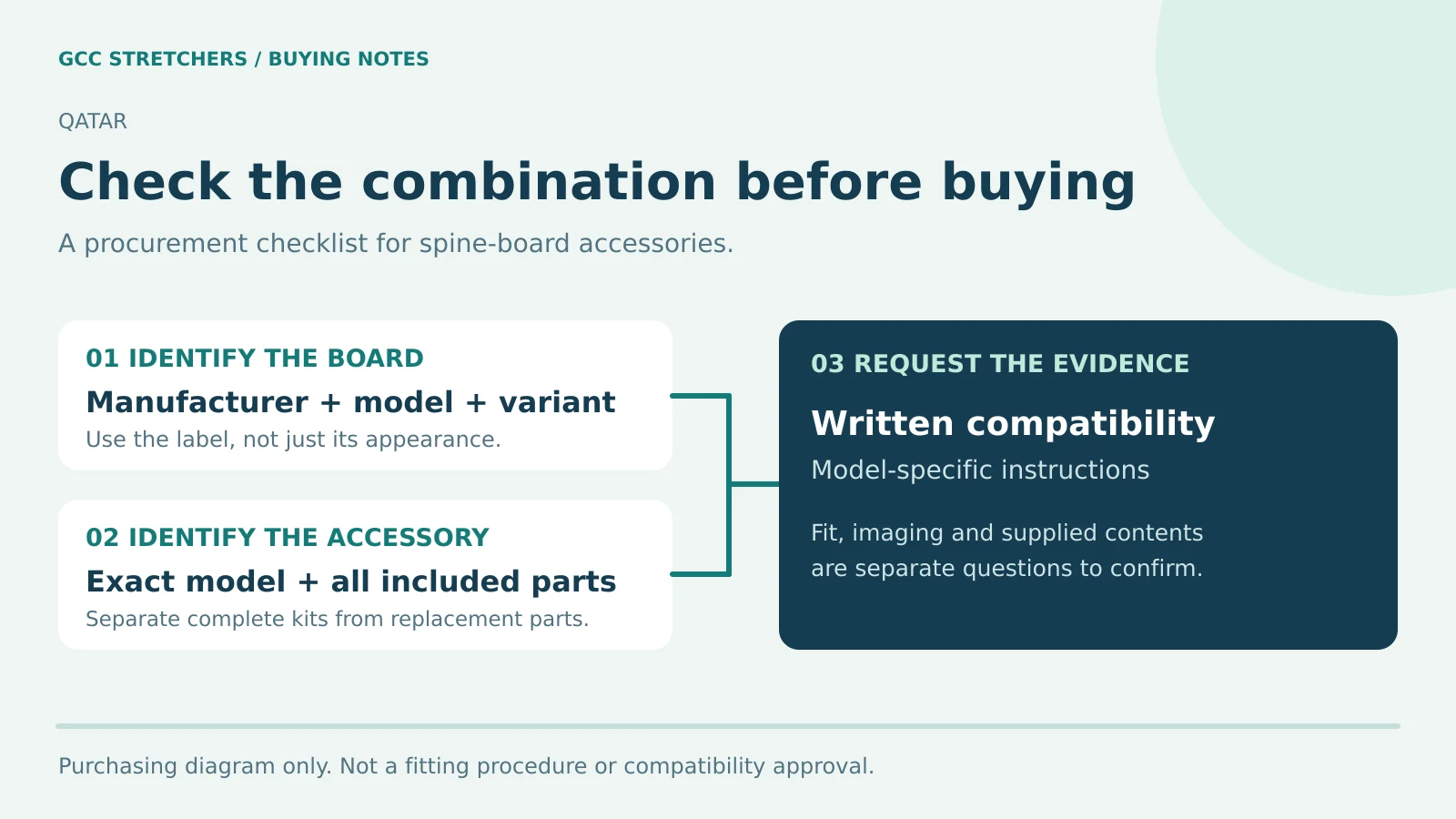
Record the board manufacturer and model from its identification label, and keep a clear photograph of that label with the enquiry. If you are buying a new board and accessories together, request the model number for every component in the proposed kit. An inventory description such as “yellow board” is not specific enough to distinguish variants.
For existing equipment, provide photographs of the attachment areas without any patient or personal information. Ask which measurements the supplier needs before collecting them. Overall board length and width can narrow the enquiry, but they do not establish the attachment geometry or approved accessory combination.
- Board manufacturer, model and any variant or revision shown
- Accessory manufacturer and exact model requested
- Whether the request is for a complete kit or a replacement component
- Manufacturer documentation already held by the facility
Separate catalogue facts from compatibility evidence
The DW-PE001 listing gives board dimensions of 186 × 46 × 6 cm and describes safety belts. That description does not identify those belts as the DW-SP01 spider-belt system, or confirm that a head immobilizer is included. Ask for the itemised supplied configuration.
The DW-FA001A listing describes an adult head immobilizer with two supports, a base plate and two straps. The DW-SP01 listing gives a centre length of 105 cm and shown strap lengths of 135, 122, 122, 120 and 90 cm. These are catalogue descriptions of separate products. They do not establish that the three products form an approved kit.
| Item | Listed information | Ask the supplier to confirm |
|---|---|---|
| DW-PE001 board | 186 × 46 × 6 cm; safety belts described | Exact belt models and complete supplied contents |
| DW-FA001A head immobilizer | Adult; two supports, base plate, two straps | Documented fit with the requested board and all mounting parts |
| DW-SP01 spider belt | 105 cm centre length shown | Attachment compatibility with the exact board model |
Sources: DW-PE001 board specifications and compatibility qualifications · DW-FA001A components and board-fit qualifications · DW-SP01 dimensions and attachment qualifications
Ask for model-specific instructions, not a generic assurance
Request the current manufacturer instructions and the document or written confirmation identifying the permitted board-and-accessory combination. A response that says only “universal” leaves the actual compatibility question unanswered.
As an example of why model-specific instructions matter, the Ferno Model 445 manual identifies particular board attachment features and permitted equipment arrangements. Those instructions apply to the Ferno product. They are not instructions for DW-FA001A, and they do not verify compatibility of any GCC Stretchers item. The procurement lesson is to obtain the corresponding documentation for the model being quoted.
WHO’s technical-specification guide lists purchasing, maintenance planning and training among the uses of technical information. Ask for the available operating, inspection and cleaning documentation for the exact supplied components so the responsible facility team can review them before acceptance.
Sources: Ferno Model 445 manual, August 2024, pages 5–6 (manufacturer-specific example) · WHO technical-specification user guide, version 1.1 (2014)
Compare complete kits and replacement parts on separate lines
When replacing one part, specify whether you need a complete head-immobilizer assembly, only a support, a base plate or straps. Ask whether the requested component is supplied separately and approved for the equipment you already hold. Do not assume that visually similar spare parts are interchangeable.
A useful comparison sheet gives each quoted component its own model, quantity, included parts, supporting document and unresolved question. Mark a reply as “confirmation pending” when evidence is missing. This prevents a lower quoted total for an incomplete assembly from being treated as equivalent to a complete kit.
Treat imaging and standards claims as separate questions
Physical attachment compatibility does not establish suitability for X-ray, CT or MRI use. The listed DW-PE001 and DW-FA001A notes ask buyers to confirm any required imaging documentation; this article does not verify an imaging capability for either product.
If your purchasing process requires a named standard or other supporting document, state the requirement and request evidence for the exact model and configuration. Ask the responsible equipment team to review the response. A statement about a different manufacturer’s product is not transferable to the item you are buying.
Sources: DW-PE001 board specifications and compatibility qualifications · DW-FA001A components and board-fit qualifications · DW-SP01 dimensions and attachment qualifications
Send a precise Qatar enquiry
Include the receiving facility and city, such as Doha, Al Wakrah or Al Khor, plus your required quantities and preferred receiving date. Ask for availability and delivery arrangements for the actual order; a city name in this guide does not imply a local warehouse or guaranteed delivery time.
A concise request could read: “Please quote [quantity] head-immobilizer assemblies for our [board manufacturer and model]. Confirm the exact accessory model, all included attachment parts, compatibility evidence and available instructions. Delivery is to [facility and city], Qatar. Please identify any unanswered compatibility requirement before proposing the order.”
For the listed GCC Stretchers items, add the required products to your quote list, select Qatar and put the board details and document requests in the requirements field. Review the prepared WhatsApp message before sending it. The quotation should resolve the model and configuration questions before your organisation approves the purchase.
Buyer questions, answered
Will any head immobilizer fit a standard spine board?
Do not assume it will. Identify both models and request manufacturer documentation for their attachment arrangement. Similar appearance or an overall board dimension does not prove compatibility.
Does the DW-PE001 include a DW-SP01 spider belt?
The board listing describes safety belts but does not identify them as DW-SP01. Ask for an itemised quotation stating which belts are included and whether the spider belt is a separate item.
Does a compatible accessory make the board suitable for imaging?
No such conclusion can be drawn from physical fit alone. Request model-specific documentation for the imaging requirement and have the responsible team review it.
What should a Qatar buyer send with an accessory enquiry?
Send board and accessory model references, required quantities, non-patient photographs if needed, requested documentation, and the receiving facility and city. Ask for written answers to any compatibility gaps.
Product details and references
- DW-PE001 board specifications and compatibility qualifications
- DW-FA001A components and board-fit qualifications
- DW-SP01 dimensions and attachment qualifications
- Ferno Model 445 manual, August 2024, pages 5–6 (manufacturer-specific example)
- WHO technical-specification user guide, version 1.1 (2014)
- GCC Stretchers Qatar supply enquiries
Prepared with AI assistance using the referenced information. Original diagrams illustrate purchasing checks, not clinical procedures. Confirm specifications and suitability with the supplier and your responsible equipment team before ordering.