
The short answer
For a Qatar warehouse or logistics hub, keep a DW-F002 folding stretcher (5 kg; 208 × 55 cm open, folds to 104 × 17 × 9 cm) at each first aid point at aisle ends and dock offices, not inside racked aisles. Where the route to an ambulance runs down a mezzanine stair or through tight turns, compare the DW-F009 stretcher chair (160 kg; 185 × 54 cm open, 97 × 54 × 9 cm folded) and the DW-SC003 scoop (44 cm wide, 168–202 cm), and confirm stair use for the exact model. Stock ICP001 cold packs by the 99-pack carton. Measure the narrowest point of each route before you order.
A warehouse is not a factory floor with shelves. Casualties happen in racked aisles shared with forklifts, on mezzanine stairs and at the loading dock, and the stretcher has to reach them and come back out along routes that change as stock moves. This guide helps Qatar warehouse, logistics and facility managers place first aid points and choose stretcher formats for those routes. It complements our guide to the factory first aid room and is a purchasing guide only: your first aid needs assessment, your HSE lead and trained first aiders decide how each item is used.
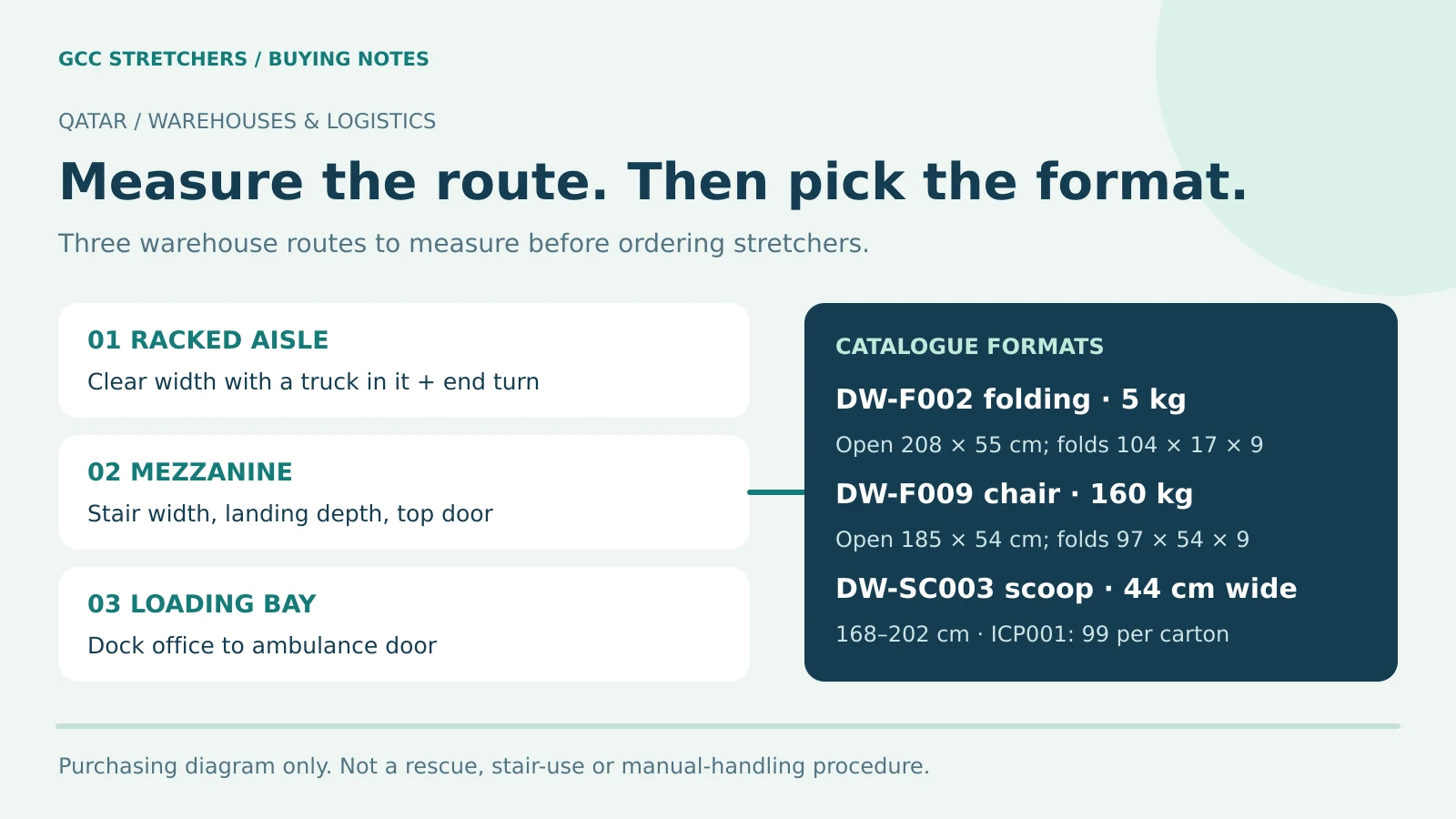
Why warehouse routes need their own plan
The UK Health and Safety Executive's warehousing guide (HSG76, second edition, 2007), used here as an example of established guidance rather than Qatar law, says vehicle movement accounts for a large proportion of accidents in warehouses, that about a quarter of major injuries are caused by slips or trips, and that manual handling, being hit by moving or falling objects and falls from height also cause many major injuries. It asks employers to assess first aid needs and to provide a first-aid box and a first-aid room depending on the size of the warehouse.
In Qatar, the English abstract of Ministerial Decision No. 16 of 2005 on medical care for workers asks for a first aid kit at each location the employer runs and one for each group of 25 workers, and the unofficial Arabic copy lists a stretcher in its first aid box contents table. A warehouse with several halls, a mezzanine and a separate dock building can therefore need more than one point. Confirm the decision's current official text and how it applies to your site with your HSE lead.
- Racked aisles: shared with lift trucks, narrow, and blocked when a pallet is being put away.
- Mezzanines and pick towers: stairs and landings set the hardest turn.
- Loading bays: vehicles, dock levellers and yard traffic.
- Offices and canteens: usually the easiest route, and often the best place for the cabinet.
Sources: UK Health and Safety Executive: Warehousing and storage, a guide to health and safety (HSG76, second edition 2007), paragraphs 14–16, 151, 159, 252–253 and 323–331 (UK guidance, cited as an example) · Gulf Labour Markets and Migration: English abstract of Qatar Ministerial Decision No. 16 of 2005 on medical care for workers · Arabic text of Qatar Ministerial Decision No. 16 of 2005 (unofficial copy hosted by the American University in Cairo, Center for Migration and Refugee Studies) · GCC Stretchers: factory first aid room equipment in Qatar
Match the stretcher format to each route
Use one row per route in your site plan. The catalogue figures below are the facts to compare; the last column lists what the catalogue does not settle, so put those questions in your enquiry.
| Route | Catalogue model | Catalogue facts | What to confirm |
|---|---|---|---|
| Racked aisles and open floor | DW-F002 double folding stretcher | 159 kg capacity; 5 kg; 208 × 55 × 13 cm open; folds to 104 × 17 × 9 cm | Fabric (the catalogue lists both nylon mesh and canvas) and the carry bag |
| Mezzanine stairs and tight landings | DW-F009 folding stretcher chair | 160 kg capacity; 8 kg net; 185 × 54 × 20 cm open; 97 × 54 × 9 cm folded; stretcher and chair configurations | Frame material (title and description differ) and written evidence before any stair use; the catalogue does not verify a stair-track system |
| Ground-level pick-up between racks | DW-SC003 adjustable scoop stretcher | 180 kg; 8 kg net; 44 cm wide; adjusts 168–202 cm; separates at both ends | Instructions for use and the immobilization items your team pairs with it |
| Emergency team set for the site | DW-PE001 spine board with DW-FA001A and DW-SP01 | 159 kg; 9.5 kg; 186 × 46 × 6 cm; integrated handholds and belts | Written compatibility of the head immobilizer and spider belt with the board |
| Every first aid point | ICP001 instant cold pack | 100 g; 14.5 × 11 cm; 99 packs per carton | Expiry and storage instructions for the supplied batch |
Sources: GCC Stretchers catalogue: DW-F002 double folding stretcher · GCC Stretchers catalogue: DW-F009 folding stretcher chair · GCC Stretchers catalogue: DW-SC003 adjustable scoop stretcher · GCC Stretchers catalogue: DW-PE001 PE spine board · GCC Stretchers catalogue: ICP001 instant cold pack · GCC Stretchers: stretcher chair or evacuation chair, a Qatar buying guide
Measure the narrowest point, not the aisle width on the drawing
HSG76 asks for gangways wide enough for mechanical handling equipment, marked walkways and walkways kept free from obstructions, especially near emergency routes and doorways. The width that matters for a stretcher is what is left when a truck, a pallet or a cage is in the aisle, and the turn at the aisle end into the cross-aisle.
Compare that clear width and turn with the open sizes: 55 cm wide and 208 cm long for the DW-F002, 54 cm and 185 cm for the DW-F009, and 44 cm wide for the DW-SC003. On a mezzanine, measure the stair width, the landing depth and the door at the top. At the dock, check the walk from the dock office to the door the ambulance will use, not just the vehicle bay. Record each measurement in your enquiry so the formats can be compared against your actual routes.
- Aisle: clear width with a truck parked, and the turning space at each end.
- Mezzanine: stair width, landing depth, door width at the top.
- Dock: route from the dock office to the ambulance pick-up door.
- Cabinet: usable inside size for a 104 × 17 × 9 cm folded DW-F002 or a 97 × 54 × 9 cm folded DW-F009.
Sources: UK Health and Safety Executive: Warehousing and storage, a guide to health and safety (HSG76, second edition 2007), paragraphs 14–16, 151, 159, 252–253 and 323–331 (UK guidance, cited as an example) · GCC Stretchers catalogue: DW-F002 double folding stretcher · GCC Stretchers catalogue: DW-F009 folding stretcher chair · GCC Stretchers: folding stretcher storage dimensions
Place first aid points where trucks are not
Keep stretchers and boxes at aisle ends, dock offices, canteens and reception, where they can be reached without walking into a live aisle and where the cabinet does not narrow a walkway. Put each point on the site plan and the first aid notices, which HSG76 says should tell employees the first aid arrangements, and include drivers and agency staff in the needs assessment.
Restock from one list. Count first aid points per hall and shift, then order ICP001 cold packs by the carton (99 packs, 47 × 30 × 24 cm, 11.8 kg gross) and DW-FA012 splints alongside the stretchers, so every point is refilled on the same schedule. Medicines and complete first aid kits come from other suppliers.
Sources: UK Health and Safety Executive: Warehousing and storage, a guide to health and safety (HSG76, second edition 2007), paragraphs 14–16, 151, 159, 252–253 and 323–331 (UK guidance, cited as an example) · GCC Stretchers catalogue: ICP001 instant cold pack · GCC Stretchers catalogue: DW-FA012 aluminium mouldable splint · GCC Stretchers: factories, warehouses and logistics equipment
What to send with a Qatar warehouse enquiry
Send one request per site or group of sites. A complete request lets each format be checked against your routes before quotation, and availability, delivery and documentation are confirmed in the quotation for each destination.
- Site name and area (for example a logistics park, Industrial Area or port zone), halls and shifts.
- First aid points per hall, and which routes include mezzanine stairs or dock doors.
- Narrowest measurements from the checklist above.
- Models and quantities: DW-F002, DW-F009, DW-SC003, DW-PE001 set, ICP001 and DW-FA012 cartons.
- Documents you need: confirmed specification, instructions for use, and any evidence you require before stair use.
- Receiving contact and delivery address for each site.
Sources: GCC Stretchers quote request · GCC Stretchers: Qatar market page
Buyer questions, answered
What stretcher should a Qatar warehouse keep at its first aid points?
A DW-F002 folding stretcher is the compact choice for most points: 5 kg, 159 kg capacity and 104 × 17 × 9 cm folded. Add a DW-F009 stretcher chair or a DW-SC003 scoop where your routes include mezzanine stairs or tight turns, after measuring those routes.
Should the stretcher be stored inside the racked aisles?
Keep it at aisle ends, dock offices or reception instead, where it can be reached without entering a live aisle and the cabinet does not narrow a walkway. Mark each point on the site plan and the first aid notices.
Can the DW-F009 stretcher chair be used on mezzanine stairs?
Its catalogue shows stretcher and chair configurations but does not verify a stair-track system or a stair-use procedure. If stairs are part of your route, ask for written evidence for the exact supplied model and have your HSE lead review it before relying on it.
How many first aid points does a Qatar warehouse need?
The English abstract of Decision No. 16 of 2005 asks for a kit at each location and one per group of 25 workers. Count halls, shifts and separate buildings, and confirm the current official requirement with your HSE lead; we quote the stretchers, splints and cold packs for each point.
Product details and references
- UK Health and Safety Executive: Warehousing and storage, a guide to health and safety (HSG76, second edition 2007), paragraphs 14–16, 151, 159, 252–253 and 323–331 (UK guidance, cited as an example)
- Gulf Labour Markets and Migration: English abstract of Qatar Ministerial Decision No. 16 of 2005 on medical care for workers
- Arabic text of Qatar Ministerial Decision No. 16 of 2005 (unofficial copy hosted by the American University in Cairo, Center for Migration and Refugee Studies)
- GCC Stretchers catalogue: DW-F002 double folding stretcher
- GCC Stretchers catalogue: DW-F009 folding stretcher chair
- GCC Stretchers catalogue: DW-SC003 adjustable scoop stretcher
- GCC Stretchers catalogue: DW-PE001 PE spine board
- GCC Stretchers catalogue: ICP001 instant cold pack
- GCC Stretchers catalogue: DW-FA012 aluminium mouldable splint
- GCC Stretchers: factory first aid room equipment in Qatar
- GCC Stretchers: stretcher chair or evacuation chair, a Qatar buying guide
- GCC Stretchers: folding stretcher storage dimensions
- GCC Stretchers: factories, warehouses and logistics equipment
- GCC Stretchers quote request
- GCC Stretchers: Qatar market page
Prepared with AI assistance using the referenced information. Original diagrams illustrate purchasing checks, not clinical procedures. Confirm specifications and suitability with the supplier and your responsible equipment team before ordering.