
The short answer
Keep the catalogue model, manufacturer identifier and your organisation’s asset ID in separate fields. DW-SC003 identifies a scoop stretcher model; it does not distinguish two physical units of that model. Ask what identification accompanies the offered equipment, then connect each unit’s verified details to its own location and records.
Ordering several identical medical stretchers for a Qatar facility creates a simple administrative problem: a later message saying “the DW-SC003 needs attention” may not identify which unit is involved. Plan the record before delivery, leaving unverified identifiers blank rather than converting a product code into a serial number.
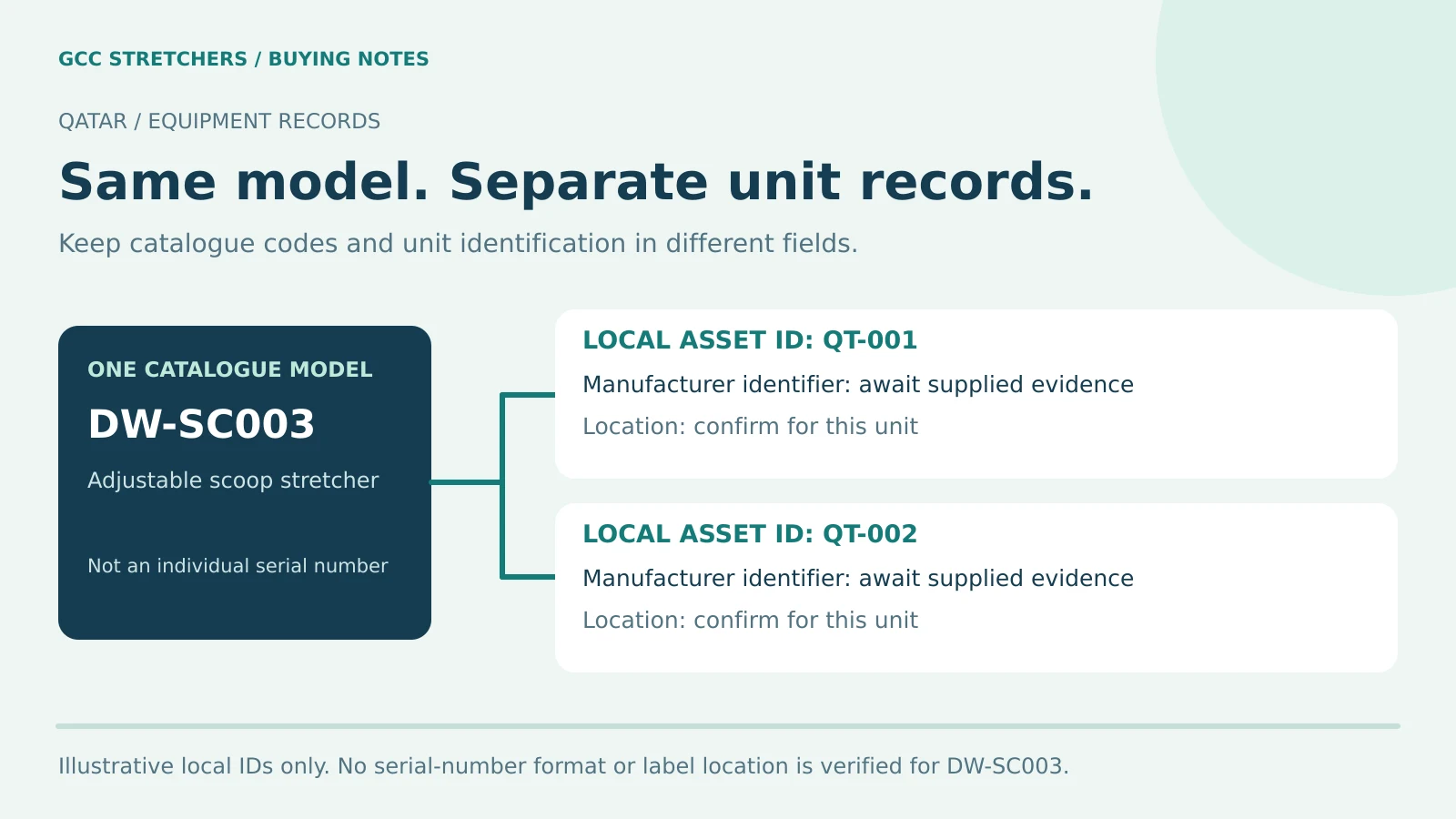
Separate the three kinds of identification
WHO’s health technology management inventory table distinguishes an equipment identifier, manufacturer/model and manufacturer serial number. It also records location, condition and update dates. This provides a useful inventory framework; it is not presented here as a Qatar legal requirement.
The catalogue names DW-SC003 as an adjustable scoop stretcher and DW-F002 as a double folding stretcher. Those references help select the product line. Neither catalogue entry establishes an individual unit serial number, barcode format or label position.
Sources: WHO health technology management: inventory fields, Figures 3.4-17 and 3.4-18 · DW-SC003 catalogue model and specifications · DW-F002 catalogue model and specifications
Use one model reference with separate unit records
Consider a fictional order for two DW-SC003 stretchers. Both quote lines or unit records may carry the same catalogue model. If your organisation assigns local references QT-001 and QT-002, keep those in an asset-ID field and leave each manufacturer-identifier field for the actual supplied information.
The example below is a draft receiving worksheet, not a record of delivered equipment. It deliberately contains no invented manufacturer serial numbers.
| Draft field | First unit | Second unit |
|---|---|---|
| Catalogue model | DW-SC003 | DW-SC003 |
| Local asset ID (illustrative) | QT-001 | QT-002 |
| Manufacturer identifier | Await supplied label/document | Await supplied label/document |
| Assigned location | Await receiving-team confirmation | Await receiving-team confirmation |
| Evidence reference | Add the unit-specific label photo | Add the unit-specific label photo |
Ask for the supplied model’s identification instructions
Ferno’s May 2024 Scoop EXL instructions provide a manufacturer example: the manual has a serial-number record field and identifies where that number is located on its own stretcher. That location and numbering system must not be transferred to DW-SC003 or DW-F002.
Ask the supplier to identify the offered manufacturer, exact model and supplied identification method. If your facility needs a readable label photograph or a list of identifiers with delivery, include that in the enquiry. Ask how to resolve an absent or unreadable identifier instead of guessing from a carton code.
A local asset ID should remain clearly labelled as your organisation’s reference. It does not replace manufacturer information or establish certification. Any physical tagging method needs review against the applicable product instructions; this guide does not prescribe a sticker position, drilling or engraving.
Sources: Ferno Scoop EXL instructions, May 2024: manufacturer identification example · DW-SC003 catalogue model and specifications · DW-F002 catalogue model and specifications
Keep changes connected to the same unit
Use the unit record to find the applicable purchase documents and inspection history. WHO’s inventory guidance includes operating/service history among useful additional data. Keep the supplier contact distinct from any separately agreed maintenance provider.
An illustrative transfer from one room to another should change the recorded location, not silently turn QT-001 into a new device. Record who updated the entry and when. If a replacement is supplied instead, retain the earlier record and create a clearly linked replacement entry under your organisation’s procedure.
For inspection responsibilities and warranty questions, use the linked guides. An organised register helps locate documents; it does not establish an inspection interval, warranty term or approval for use.
Sources: WHO health technology management: inventory fields, Figures 3.4-17 and 3.4-18 · Medical stretcher inspection planning · Stretcher warranty and spare-parts buying checklist
Include the identification request in your Qatar enquiry
A useful request is: “Please quote [quantity] [catalogue model] for [facility and Qatar city]. Confirm the offered manufacturer and model, the identification supplied with each unit, and whether unit-specific label photographs or an identifier list can accompany delivery. Please identify any documentation still awaiting confirmation.”
Keep the order quantity and proposed local asset references separate. Add the receiving contact and any required document format. Availability, identification details and delivery arrangements must be confirmed in the quotation; an asset-record template is not evidence of stock or a documentation service.
Sources: Qatar equipment enquiries · DW-SC003 catalogue model and specifications · DW-F002 catalogue model and specifications
Buyer questions, answered
Is DW-SC003 a serial number?
No. It is the catalogue model reference for the adjustable scoop stretcher. The available catalogue does not establish the individual identifier supplied with each physical unit.
Can two stretchers have the same model code?
Yes. The code identifies the model. Keep separate unit records and copy each supplied manufacturer identifier accurately; use clearly separate local asset IDs where your organisation assigns them.
What if the manufacturer identifier is missing or unreadable?
Record that it is unconfirmed and ask the supplier for the applicable identification information. Do not invent a serial number or copy one from another unit. Follow your organisation’s acceptance process.
Does an asset record prove a stretcher is ready for use?
No. Identification records are administrative. The responsible team must separately follow the supplied instructions and its equipment acceptance and inspection procedures.
Product details and references
- WHO health technology management: inventory fields, Figures 3.4-17 and 3.4-18
- Ferno Scoop EXL instructions, May 2024: manufacturer identification example
- DW-SC003 catalogue model and specifications
- DW-F002 catalogue model and specifications
- Medical stretcher inspection planning
- Stretcher warranty and spare-parts buying checklist
- Qatar equipment enquiries
Prepared with AI assistance using the referenced information. Original diagrams illustrate purchasing checks, not clinical procedures. Confirm specifications and suitability with the supplier and your responsible equipment team before ordering.