
The short answer
For a multi-site Saudi Arabia order, give each receiving location a site code, record quantities by model and site, then reconcile the site allocations with the total order. Compare supplier responses against that same list and keep changes under one revision number.
Buying stretchers for several locations creates a different problem from buying for one facility: the total can be correct while the allocation is wrong. A project in Riyadh might need different equipment or receiving arrangements from a site in Jeddah or Dammam. When ordering medical equipment for Saudi Arabia, use one master list with a separate allocation for each destination. The approach below helps your purchasing team compare responses and keep individual site requirements visible.
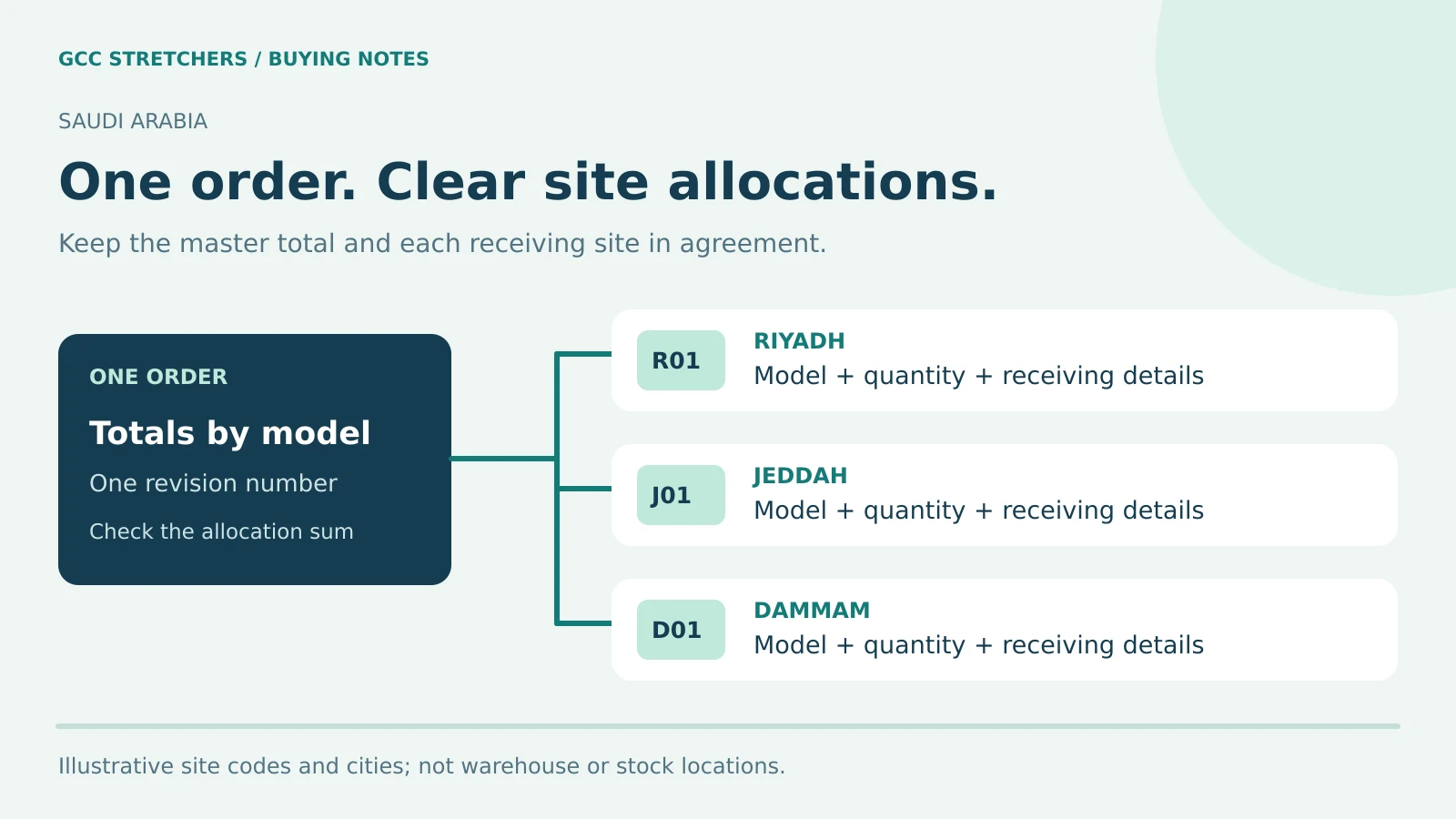
Build the order around site codes, not just cities
Give every destination a short, unique code that your team can use throughout the enquiry, quotation and receiving process. A city name alone is not enough when two facilities are in the same city. Pair the code with the facility name, complete receiving address and a contact responsible for that location.
Keep one line for each combination of site, product model and configuration. Add a separate status field for anything still awaiting approval. This makes it clear which quantities are ready to quote and which are only provisional. It also prevents an unconfirmed request from being mistaken for a final order.
- Site code and facility name
- City, receiving address and site contact
- Equipment model and configuration
- Quantity requested and quantity confirmed
- Required receiving date and any unresolved questions
Reconcile the site breakdown with the supplier total
Consider this illustrative allocation, not a recommendation for how much equipment any facility needs: site R01 requests two DW-F002 folding stretchers, site J01 requests one DW-F002, and site D01 requests one DW-SC003 scoop stretcher. The supplier summary should therefore show three DW-F002 units and one DW-SC003 unit, with the destination breakdown preserved.
Avoid summarising that list as ‘four patient transport stretchers’. The total conceals two different models and loses the allocation. Ask for both views in the quotation: a model-by-model total and a site-by-site breakdown. Your operational team should determine the actual equipment types and quantities required for each facility.
Sources: DW-F002 folding stretcher dimensions and configuration notes · DW-SC003 scoop stretcher dimensions
Standardise only the details that really match
Using one model across several sites can simplify a purchasing list, but it should not replace a check of each site's requirements. Record any difference in storage space, requested accessories or documentation before grouping the quantities.
For a concrete storage comparison, GCC Stretchers’ DW-F002 listing gives folded dimensions of 104 × 17 × 9 cm. The DW-SC003 listing gives folded dimensions of 120 × 44 × 9 cm. These catalogue dimensions describe different formats; they do not establish clinical suitability or tell you the clearance needed to unpack and handle the equipment. Confirm the supplied configuration and packed dimensions when planning storage or delivery access.
If a supplier proposes a substitute, keep it on a separate line until the responsible buyer approves it. Record the proposed model and the differences from the requested specification instead of silently replacing the original reference.
Sources: DW-F002 folding stretcher dimensions and configuration notes · DW-SC003 scoop stretcher dimensions
Keep accessories attached to their destination
A central accessory total can hide an incomplete setup at one location. Where a site requests a board and accessories, list the board, head immobilizer and restraint items against that same site code. Ask which items are included with the quoted model and which are separate order lines.
For example, an enquiry involving the DW-PE001 spine board and DW-FA001A adult head immobilizer should request confirmation of the exact supplied combination. Do not infer compatibility from a product photograph or assume that every accessory is supplied with the main equipment. If the accessory is for an existing board, include its model in that site's notes.
Sources: DW-PE001 spine board and accessory confirmation · DW-FA001A adult head immobilizer compatibility notes
Compare delivery responses for each location
Separate your preferred receiving dates from the supplier's confirmed dates. Ask whether the proposed order would arrive together or in separate consignments, and whether delivery to each named destination is included in the quoted arrangement. Availability, costs and timing must be confirmed for the actual order.
WHO's published procurement process describes considering delivery time and functional characteristics alongside other factors when comparing offers. That is a useful general reminder to compare the whole response, not only its headline total. It describes WHO's process; it is not a Saudi procurement requirement or a certification of any GCC Stretchers product.
For your own comparison sheet, keep a column for each supplier's response to the requested models, accessory configuration, supporting documents and delivery plan. Mark unanswered items as open rather than assuming that an omission means agreement.
Sources: WHO procurement principles and processes — evaluation of offers
Maintain one version of the allocation through receiving
Date or number each revision of the site allocation. When a quantity changes, update both the destination line and the master total, then ask the supplier to acknowledge the revised list. Agree how site codes will appear on the packing information so that receiving teams can match a delivery to the intended location.
At receipt, compare the delivered model identifiers and quantities with the confirmed allocation and record any discrepancy for the supplier to resolve. The organisation's responsible team should handle equipment acceptance and suitability checks; a matching carton count alone does not complete those checks.
Send GCC Stretchers the totals and the site breakdown
Add your selected products and total quantities to the GCC Stretchers quote list, choose Saudi Arabia as the delivery country, and put the site codes, receiving cities and allocation in the requirements field. If the full list is too long, summarise it and state that you will share the detailed allocation in the WhatsApp conversation.
The form prepares a request for the Saudi Arabia team. Review it before opening WhatsApp and pressing Send. Ask the team to confirm model availability, included accessories, documents and delivery arrangements for every location before the order is agreed. This keeps the first conversation focused on the differences that matter across your sites.
Buyer questions, answered
How should I split a Saudi Arabia equipment order between sites?
Use one line per site and model, with a site code, receiving city and quantity. Reconcile those lines with the total ordered for each model before approving the quotation.
Can the same model be used at every facility?
Only if the responsible equipment team confirms that each site has the same requirements. Storage dimensions, configuration and accessory needs can differ.
What should I do if the supplier proposes a substitute?
Record the proposed model and its differences on a separate line. Obtain the responsible buyer’s approval before changing the agreed order or site allocation.
Product details and references
- DW-F002 folding stretcher dimensions and configuration notes
- DW-SC003 scoop stretcher dimensions
- DW-PE001 spine board and accessory confirmation
- DW-FA001A adult head immobilizer compatibility notes
- GCC Stretchers Saudi Arabia supply enquiries
- WHO procurement principles and processes — evaluation of offers
Prepared with AI assistance using the referenced information. Original diagrams illustrate purchasing checks, not clinical procedures. Confirm specifications and suitability with the supplier and your responsible equipment team before ordering.