
The short answer
Use DW-CC001A for an enquiry about the adult catalogue model and DW-CC001B for the child model. Keep them on separate quote lines and ask for the exact supplied model, current product identification and manufacturer sizing instructions. The catalogue uses one illustration for both; its dimensions are not a patient-fitting chart.
When a purchasing list says “cervical collars,” the first clarification is the actual model required. The GCC Stretchers catalogue has separate adult and child PE collar entries, and the same reference image appears on both. This guide helps Qatar procurement teams identify and document those entries. It does not advise whether a patient needs a collar or explain fitting, adjustment or treatment.
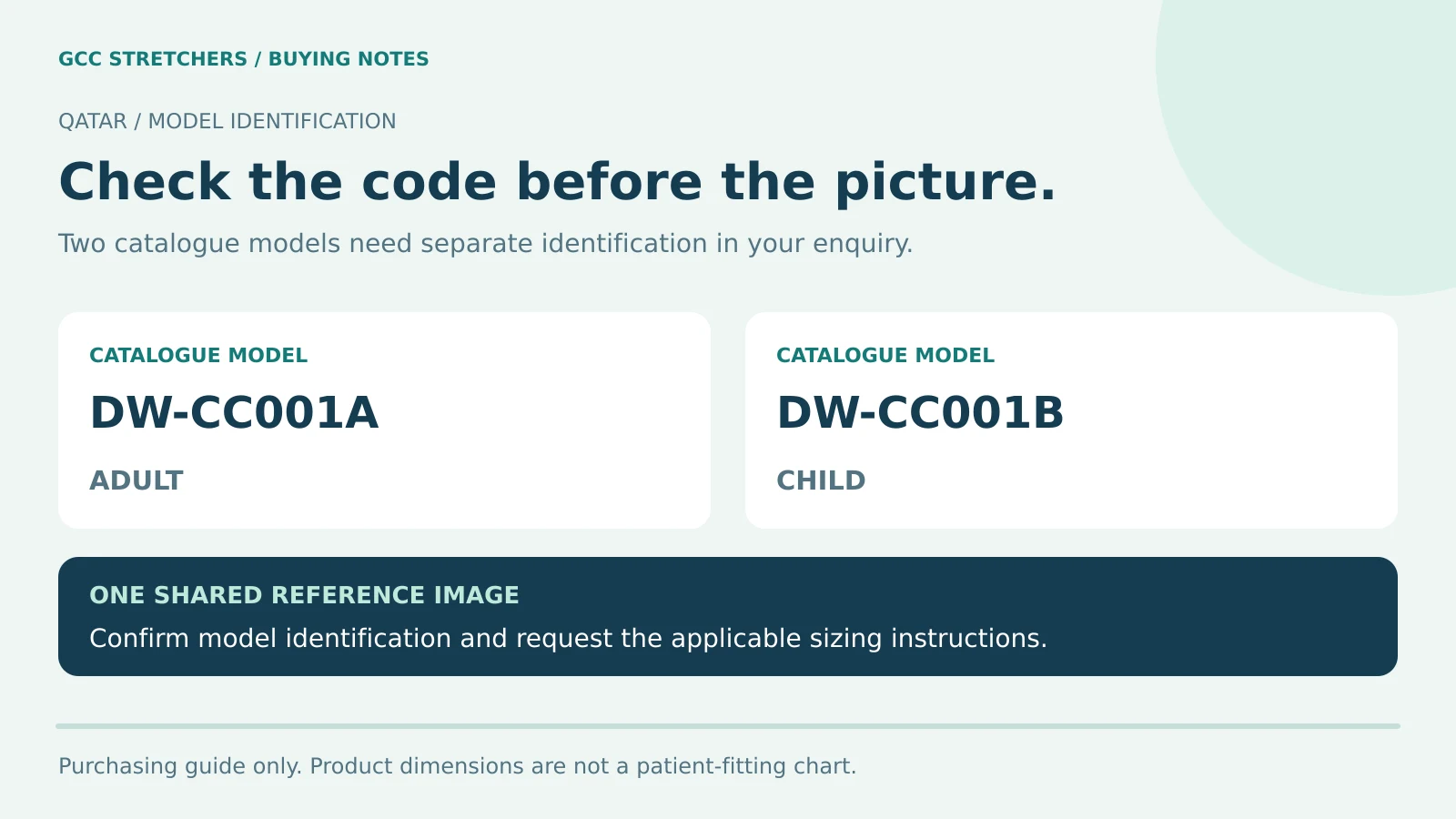
Compare the two catalogue entries by model code
The final letter distinguishes these two product codes: DW-CC001A is the adult entry and DW-CC001B is the child entry. Retain the full code when requesting a quotation, especially if your team needs both. A photograph, a generic description or the shared DW-CC001 prefix is not enough to specify the variant.
The table reproduces the existing catalogue details. Ask the supplier to confirm them for the offered product; do not use the figures as a clinical selection rule.
| Catalogue field | DW-CC001A | DW-CC001B |
|---|---|---|
| Listed size group | Adult | Child |
| Listed material | PE | PE |
| Catalogue dimensions | 56 × 19 × 0.5 cm | 47 × 17 × 1 cm |
| Listed net weight | 0.2 kg | 0.1 kg |
| Product identification | Confirm adult model on offered item | Confirm child model on offered item |
Sources: DW-CC001A adult collar catalogue details · DW-CC001B child collar and shared-image note
Treat the shared image as a reference, not variant evidence
The child product entry already notes that the catalogue uses the same illustration for both sizes. The gallery now identifies that limitation beside the image. Enlarging the shared picture can help you inspect the reference illustration, but it cannot establish which model will be delivered.
For a model-sensitive enquiry, request a current photograph of the offered item and its product identification, plus its corresponding specification. Keep the model code in the written response. Do not infer a colour, adjustment feature or supplied component solely from the shared illustration.
Sources: DW-CC001A adult collar catalogue details · DW-CC001B child collar and shared-image note
Keep product dimensions separate from sizing instructions
The measurements in the comparison are labelled as catalogue dimensions. The product pages do not supply a neck-circumference range, a patient-height range or a complete manufacturer fitting chart for either model. Do not relabel 56 cm or 47 cm as an approved neck measurement, and do not derive patient age bands from those figures.
As a manufacturer-specific example, Laerdal distinguishes adult and pediatric Stifneck Select models and provides its own sizing information. That demonstrates why the exact model documentation matters. Its adjustment positions, identification colours, imaging statements and instructions are not evidence for DW-CC001A or DW-CC001B. Patient selection and application must remain with the responsible clinical team using the correct supplied instructions.
Sources: DW-CC001A adult collar catalogue details · DW-CC001B child collar and shared-image note · Laerdal Stifneck Select product information (different models)
Do not substitute a different collar type by name alone
A search for “cervical collar” can lead to different product families. For the GCC Stretchers entries discussed here, the catalogue specifies PE and separate adult and child models. It does not establish equivalence to a soft foam collar or to another manufacturer’s adjustable model.
If the requested specification calls for a particular design, sizing range or documented capability, include that requirement verbatim in the enquiry. Ask the supplier to identify any difference in the proposed product before the responsible team reviews it. Do not assume a matching category name resolves the specification.
Sources: DW-CC001A adult collar catalogue details · DW-CC001B child collar and shared-image note
Request evidence for the exact offered item
WHO’s technical-specification guidance supports reviewing specifications before purchase. For this comparison, keep a short record of the requested model, the model offered, the document supplied and any unresolved difference. The WHO guidance is general procurement context, not approval of these collars or a Qatar regulatory requirement.
Useful questions are specific enough to receive a written answer. Ask which model and variant will be supplied, which instructions apply to it and whether the supplier can document the particular requirements in your purchasing specification. If information is unavailable, mark it as unconfirmed rather than borrowing a claim from another product page.
- Confirm the full model code and adult or child catalogue designation.
- Request model-specific sizing and use instructions for the responsible clinical team.
- Ask for a current item or label image when the shared catalogue illustration is insufficient.
- List any required materials, compatibility or imaging documentation as separate questions.
Sources: WHO: procurement and technical specifications · DW-CC001A adult collar catalogue details · DW-CC001B child collar and shared-image note
Prepare a clear Qatar quotation request
Keep adult and child quantities on separate lines. An illustrative request could say: “Please quote DW-CC001A adult collars and DW-CC001B child collars in the quantities shown on our equipment list. Confirm the exact supplied models and provide current identification images, specifications and the applicable manufacturer instructions. Please flag any substitution before order confirmation.”
Add your organisation, exact receiving location in Doha, Al Rayyan, Al Wakrah or elsewhere in Qatar, and the documents your procurement team requires. These are possible enquiry destinations, not warehouse claims. Availability, accepted quantities, delivery arrangements and timing are confirmed in the quotation. Use this guide’s Qatar enquiry link to continue with your requirements.
Sources: Qatar equipment enquiries · DW-CC001A adult collar catalogue details · DW-CC001B child collar and shared-image note
Buyer questions, answered
Which catalogue code is the adult collar?
DW-CC001A is listed as the adult PE cervical collar. DW-CC001B is the separate child model. Keep the complete code and requested quantity on each enquiry line.
Does the shared collar photograph prove which size I will receive?
No. The catalogue uses the same illustration for both entries. Ask for the model identification and a current image of the offered item when you need to verify the variant.
Are the listed centimetre dimensions a patient sizing chart?
No. They are catalogue product dimensions. Request the manufacturer sizing instructions for the exact supplied model; the responsible clinical team should determine patient suitability and fit.
Can I assume features listed for another brand also apply here?
No. Adjustment, material, imaging and compatibility statements must be verified for DW-CC001A or DW-CC001B specifically. Another brand’s documentation does not establish those capabilities for these models.
Product details and references
- DW-CC001A adult collar catalogue details
- DW-CC001B child collar and shared-image note
- Qatar equipment enquiries
- Laerdal Stifneck Select product information (different models)
- WHO: procurement and technical specifications
Prepared with AI assistance using the referenced information. Original diagrams illustrate purchasing checks, not clinical procedures. Confirm specifications and suitability with the supplier and your responsible equipment team before ordering.